
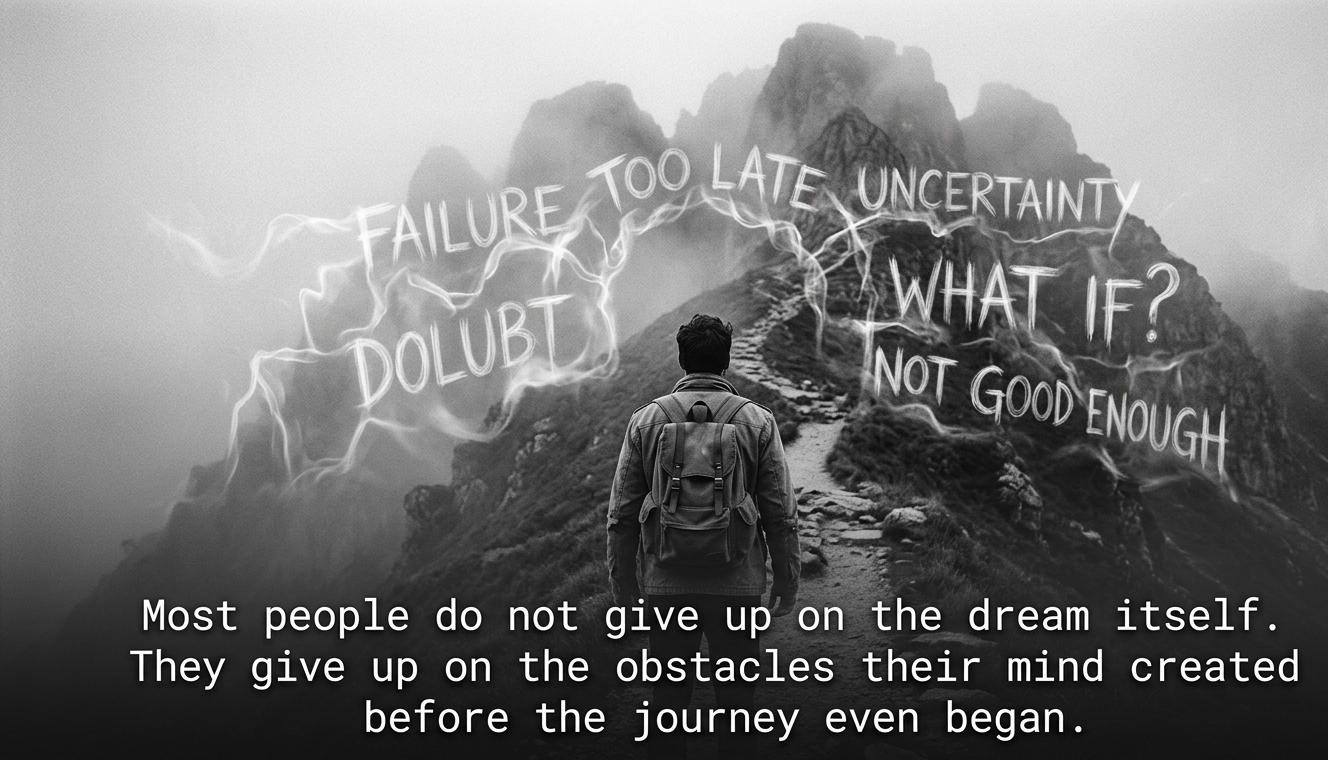
We often attribute a lack of progress to laziness or a lack of talent. But if we look closer at the lifecycle of an idea, we find that most dreams don't die from a lack of potential - they die from a specific type of mental exhaustion.
The journey from a spark of inspiration to a real-world result follows five distinct stages. Understanding where you are in this process is the key to moving forward.
Stage 1: The Spark
It starts with a flash of inspiration. A goal, a project, or a new version of your life. At this stage, the dream is pure, unburdened by logistics or reality. It is a moment of pure potential.
Stage 2: The Mental Cinema
You begin to see yourself acting and succeeding. Your mind plays a "highlight reel" of the result, creating a surge of excitement. You can already feel the joy and the satisfaction of reaching the finish line.
Stage 3: The Macro-Map
The planning begins. You stop looking at the "win" and start looking at the bridge between here and there. You visualize the road from the very beginning to the very end. You aren't just looking at the first step; you are looking at all 1,000 steps at once, trying to solve the entire journey before you’ve even left the house.
Stage 4: The Risk Scan
Your brain begins to scan that map for everything that could go wrong. You see the potential for embarrassment, financial loss, or wasted time. You begin to "carry" the weight of every future obstacle before you’ve even encountered them. In your imagination, the wall between you and the dream grows taller and heavier.
Stage 5: The Final Fork
Once the mind has felt the weight of these imagined obstacles, you arrive at a definitive crossroads. You must choose one of two paths:
Option A: The Actor - The Path of Experience
The Actor acknowledges the risks, but they make a conscious choice: they refuse to carry the whole journey at once. They don't try to solve Stage 4 problems until they actually arrive at them.
When they succeed: It is because they managed their mental load by focusing only on the immediate next step.
When they fail: While it hurts, they gain real-world data, experience, and the peace of mind that comes from knowing they tried. They leave the situation with zero "what ifs."
Option B: The Silent Quitter- The Path of Regret
The Silent Quitter allows the "imagined obstacles" to become their reality. They look at the 1,000-step map, feel the weight of every potential mistake, and decide the price of entry is too high.
The Result: They avoid the sting of failure, but they trade it for the long-term ache of a dream left on the shelf. As time passes, they carry an increasingly heavy weight of regret, haunted by the "what if" of a life they never dared to start.
The Way to Your Dream
Don't give up on the dream - give up on the imagined obstacles. You do this by reducing the size of your steps until the fear disappears.
Think of the goal you are currently stuck on. Now, strip away the 1,000-step map and find a step so small it feels silly not to do it.
For example:
If you want to start a business, the way forward is naming a folder on your desktop.
If you want to get fit, the way forward is putting on your gym shoes.
If you want to learn a language, the way forward is learning one single word.
Real obstacles are handled one by one. Imagined obstacles are handled by refusing to carry them at all.
What is the most ridiculous, tiny step you can take toward your dream in the next five minutes?
