
A person can be physically present in their life and still be psychologically absent from it.
This happens more often than we tend to notice.
From the outside, life appears intact - stable, capable, well-managed. Responsibilities are met. Things move forward. Nothing seems obviously wrong.
And yet inwardly, something is missing.
Because while life unfolds in the present, the mind does not always remain there.
It moves backward - into conversations that never ended the way we wanted, into decisions we regret, into words we did not say.
Or it leans forward - toward a future where life will finally begin: when things are clearer, safer, easier, or more aligned.
The body remains here.
But inwardly, many people are living somewhere else.
When the Mind Makes a Home Outside the Present
When we feel stuck, it is often not because life has stopped, but because our inner life has moved into the past or the future and settled there.
Some people live primarily in the past- They revisit what should have happened differently. A moment replays. A decision is retried. An old mistake becomes a private courtroom where the verdict is never final. Regret and guilt remain active, as if repetition could produce a different ending.
Others live primarily in the future - They orient toward a version of life they have not yet reached - when they are more secure, more accomplished, more certain, more “enough”. Or they rehearse what might go wrong, hoping worry will protect them from uncertainty.
In both cases, something essential is lost:
Life continues, but the person is no longer fully there for it.
They are functioning, but inwardly absent.
They are participating in life, but not fully inhabiting it.
The Shift: Using Time as a Tool - Not a Place to Live
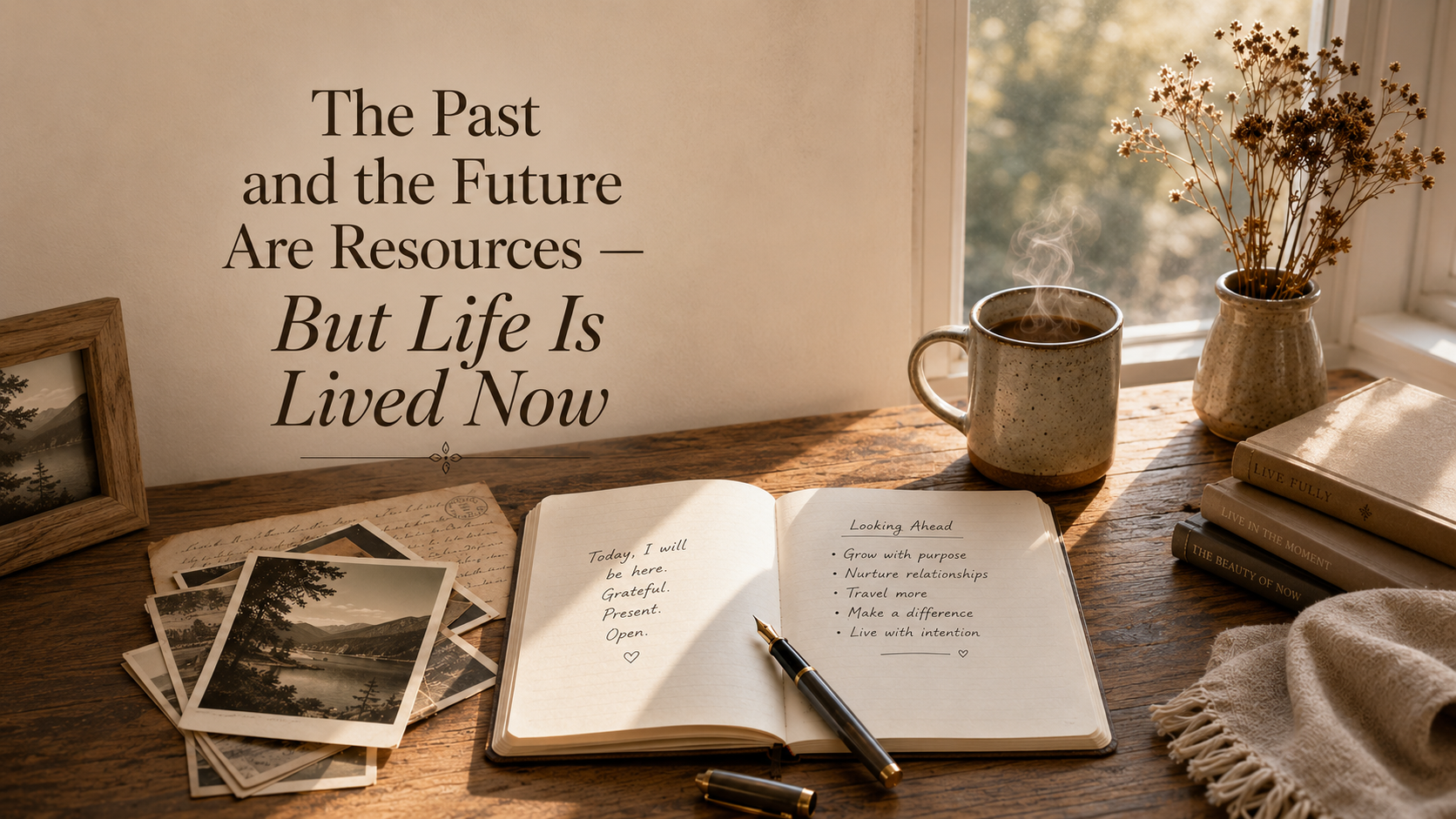
The past and the future are not the problem. Both are necessary. But they are meant to be resources, not places to live.
The past offers us evidence. It is a place for reflection. We can look back and ask: What did this teach me? What worked? What went wrong? What can I carry forward instead of continuing to carry regret?
The future provides us direction. It is a source of orientation. We can look ahead and ask: What kind of life am I trying to build? What am I ready to release? What capacities will that future require from me?
When we lose this distinction, time begins to work against us:
We return to the past not to learn, but to relive.
We move into the future not to orient, but to escape.
The Choice vs. The Step
You can make a choice anywhere.
You can choose to change while reflecting on the past. You can choose a new direction while imagining the future.
But you can only take the step now.
The present is the only place where insight becomes action. It is the only place where a boundary can be set, a truth can be spoken, a pattern can be interrupted, a conversation can begin, a decision can be acted on, or a different way of living can start to take form.
Many people wait for - clarity, confidence, the right moment.
But change does not begin when everything feels complete.
More often, it begins when a person is present enough to take one honest step inside the life they already have.
And later, they see that the future they longed for was built not through one dramatic act, but through small, consistent steps taken in the present.
What This Costs Us
Children grow. Relationships change. Seasons of life pass.
And sometimes, the deepest pain is not that life was difficult, but that we were not fully there for it.
We were waiting for life to begin later.
Or arguing inwardly with what had already happened.
But life is not in the past.
And it is not in the future
It is here:
The past was meant to teach.
The future was meant to orient.
The present is meant to be lived.
The real question is not whether you think about where you have been or where you are going.
The question is:
Are you available to your own life while you do so?
The “Return to Now” Practice
When you catch yourself living in the past or the future, you do not need to fight your thoughts. You simply need to return to your body.
The mind can travel - the senses cannot.
Use them to come back:
See: Look around. Notice three things you usually overlook.
The texture of a surface. The way light falls. The colour of your hands.Listen: What is the furthest sound you can hear? What is the closest? Just notice them without judging them.
Feel: Notice the weight of your body in the chair. Feel the fabric of your clothes against your skin. Notice the contact of your feet with the floor.
Smell and breathe: Take a deep breath through your nose. Notice the temperature of the air. Is there a scent of coffee, rain, or simply the stillness of the room? Follow that single breath until it leaves your lips.
Taste: Take a sip of water or a bite of fruit or chocolate. Let that clear sensation bring you fully back into the present moment.
In that moment, you are no longer thinking about your life.
You are back inside it.
From that place, ask yourself:
What is one small, honest step I can take now?
