
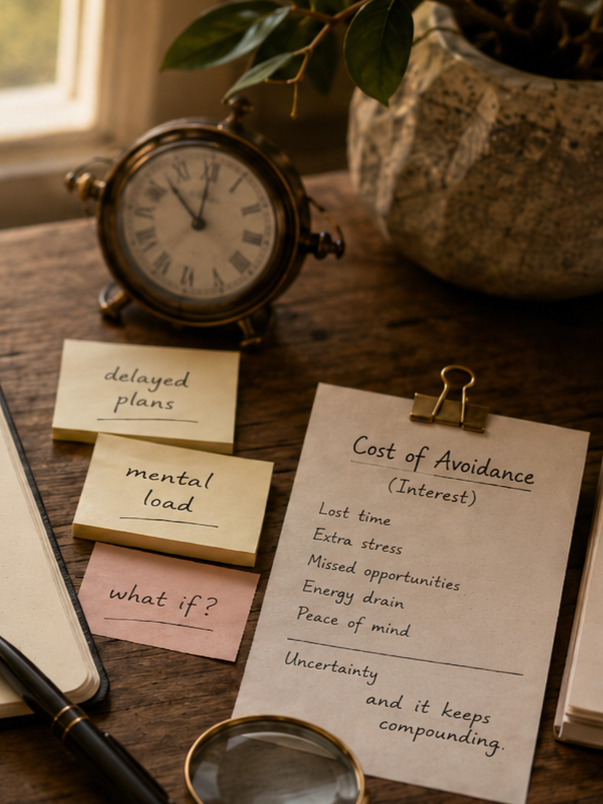
The Cost of the decisions we don’t make
Sometimes life functions perfectly well on the surface - yet inside, a feeling emerges that something needs to change. Nothing is collapsing, but continuing as you were no longer feels possible.
At this point, we usually move in one of three directions:
The Choice to Act: We think it through, accept the uncertainty, and knowingly pay the price that comes with change.
The Choice to Stay: We consciously decide to keep what we have and accept the limits of that decision.
The Choice to Avoid: We try not to decide at all.
No discount for waiting
This third option feels safer, as if postponing the decision postpones the cost. But life doesn't stand still: circumstances evolve, commitments pile up, and eventually, a direction forms anyway.
The difference is simple: When we choose, we buy the outcome we want at a price we know ahead of time. We pay the upfront cost to secure our future. When we avoid the decision, we are gambling. We lose control over both the result and the final price. We aren't skipping the payment. We are simply letting life decide the bill, and life rarely offers a discount for waiting.
The Hidden Cost of Hesitation
Avoiding a decision doesn’t preserve energy - it slowly consumes it. Instead of moving forward, we spend mental effort maintaining uncertainty: replaying thoughts, justifying the present, and reassuring ourselves that "it will all work out." The cost is not a single moment of discomfort, but a continuous inner negotiation.
Regret as a Signal
Regret does not always mean a mistake was made. Sometimes it points to a value that remained unexpressed. A conscious decision may still bring difficulty, but it usually brings clarity. You may not like every consequence, yet you understand why you chose it. Avoided decisions rarely bring that clarity - only the question of what might have happened if you had acted.
Paying Upfront vs. Paying with Interest
A clear decision hurts once. It is an upfront cost.
Avoiding it, however, is like buying on credit: it creates smaller payments over time, but they come with hidden interest and high fees. These "fees" are the postponed conversations, the delayed plans, and the constant mental weight of an unresolved life. By the time you finally face the situation, the total cost - to your energy and your peace of mind - is much higher than if you had simply paid the price at the start.
Change Begins with Awareness
The difficulty is rarely the decision itself, but trying to navigate it while being alone with your thoughts. Without a structured space to examine it, reflection turns into doubt, pressure, or avoidance. Change begins when the situation can be looked at directly instead of managed indirectly.
Professional coaching is the appropriate tool for this transition. It provides the objective mirror and the structured environment needed to stop the "internal negotiation" and start making clear, value-based decisions.
If you are ready to stop paying the interest on your indecision and want to reclaim your clarity, I invite you to join me in this space.
So, an honest question for the mirror: What in your life are you currently paying for in installments, and how much "interest" is it costing you?
