
Procrastination
Not a Character Flaw, But a Signal of a Self-Trap
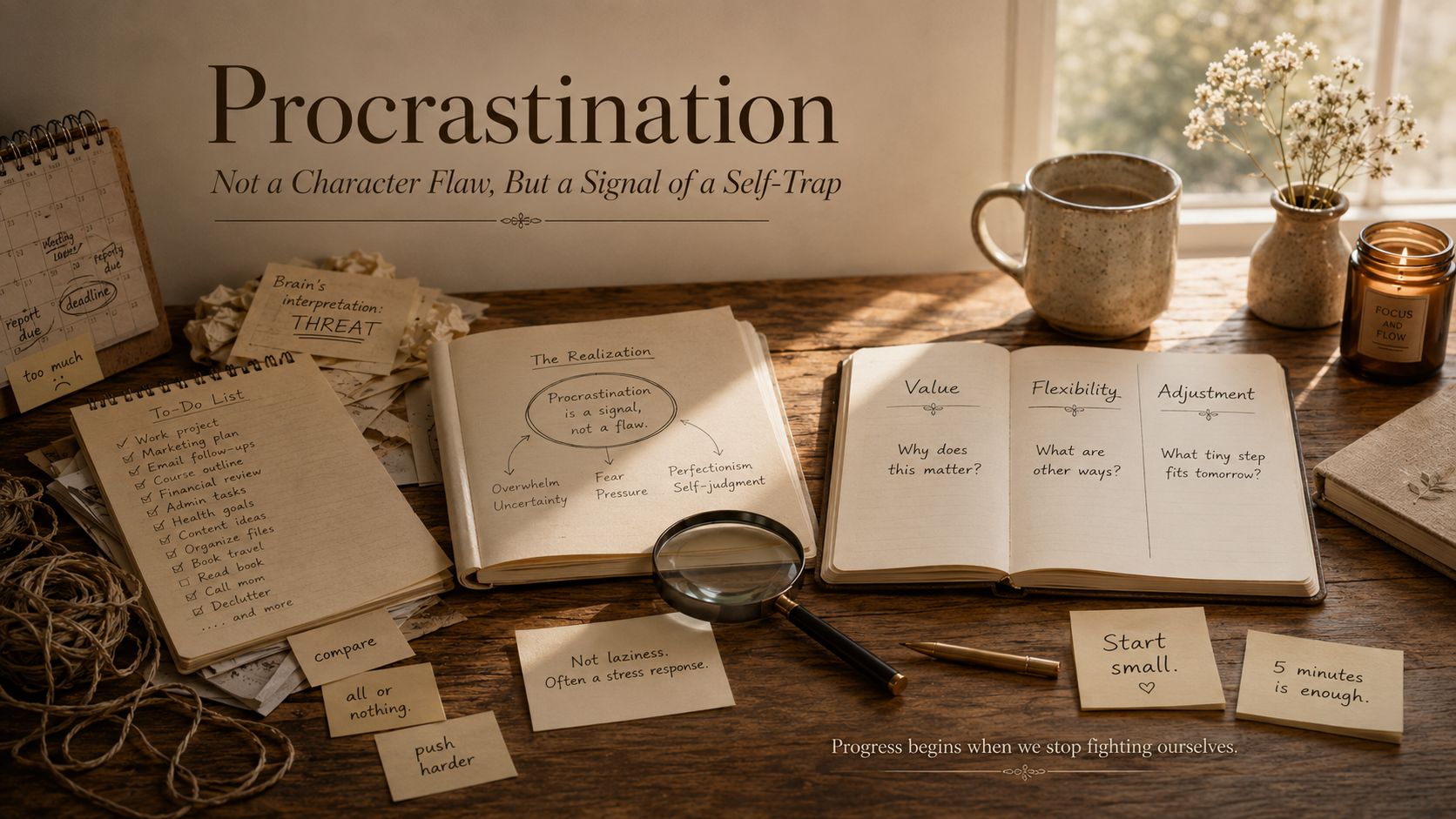
Many of us know this moment: a quiet, stinging realization when we look in the mirror and realize it’s happened again. We promised ourselves, “This time will be different. It starts today.” And then the day ends, and nothing has changed.
Instead of making progress, we are left with a heavy knot in our chest and a cruel inner voice whispering:
"I'm just weak... I have no discipline... I’ll never achieve my dreams..."
I am here to offer you a different perspective - This voice is missing the full picture.
In many cases, our procrastination is not laziness. It can be a defense mechanism that has backfired and turned into a trap. Studies in the fields of psychology and neuroscience offer a fascinating perspective: one of the central causes of procrastination is a sophisticated self-trap of emotional regulation.
The way it works: when our brain identifies a task that triggers stress, uncertainty, or fear of failure, it begins to interpret the situation as a literal threat. To protect us from this emotional pain, it chooses procrastination over the future benefit.
The Comparison Trap
We tend to compare ourselves to others instead of listening to our own internal rhythm and considering our unique strengths and weaknesses. We try to shrink ourselves into frames that work for others by asking ourselves:
"How are the others succeeding?"
Then we adopt extreme paths that worked for someone else, and leave no room for ourselves to be our "true selves."
When we decide on an "all or nothing" change, or when we set a schedule that ignores our own exhaustion, we are not just failing to build success. We might be building a plan that the brain interprets as a threat. In such a state, the brain may refuse to cooperate, placing a high wall between us and our success. A situation that, in practice, manifests as procrastination that hinders our progress toward our goal.
The Path to Freedom
In these cases, progressing toward our goal doesn’t return through more self-criticism, an endless internal war, or tapping into more willpower that burns out fast.
It returns through self-compassion and self-awareness. Once we understand the mechanism of the trap, we can stop fighting ourselves and start working with ourselves in a way that better reflects who we truly are.
Next time, before you try to "push" harder, stop for a moment and ask yourself:
Value: What deep need does this goal actually serve for me?
Flexibility: What different ways exist to get there, besides the "accepted" path?
Adjustment: What tiny action can be integrated into my life already tomorrow, without triggering the threat mechanism?
The secret lies in choosing a small, actionable first step. One that doesn’t require peak motivation, but only a simple desire to move forward.
Because progress isn’t a long-distance sprint, but a sequence of moments in which we choose to break free from the trap and not give up on ourselves.
Change Begins with Awareness
Professional coaching is the appropriate tool for this transition. It provides the objective mirror and the structured environment needed to stop the "internal self-criticism" and start making clear, value-based decisions rooted in self-compassion and self-awareness. If you are ready to break free from the trap and not give up on yourself, I invite you to join me in this space.
Ask yourself:
Which task have you been putting off repeatedly lately?
How can you break free from the trap and start moving toward your goal?
